In February 2008 I bought a registered
dun Quarter Horse mare at auction in San Antonio Texas. I was in the market for a horse I could show
at buckskin and AQHA shows. This is the
story of that mare - Babes Little Twister; her challenges and successes.
The document encompasses the period
between buying her and the start of Babe's blog on Nov. 19, 2009. To follow the
blog click here.
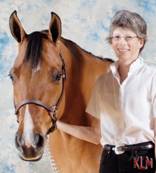
Eleanor Blazer and Babes Little Twister
All images and videos are
copyright Eleanor Blazer and cannot be utilized without explicit written
permission. elblazer@gvtc.com
________________________________________________________________________
Feb. 8, 2008 - San Antonio Select Horse
Sale:
This evening is a pre-view of horses
offered at auction. The sale catalog
lists a registered 2000 dun Quarter Horse mare.
According to the information she has AQHA points in showmanship and
halter. Her name is Babes Little Twister.
My husband, Don Blazer, and I located her
stall. There she was, standing quietly,
her head in the corner and rump to the door.
Her body language sent the message: "Leave me alone."
We went in to look at her. She laid back her ears, but did not offer to
kick or bite. We started our evaluation
of her.
The mare was extremely overweight. Her hocks and fetlocks were swollen. Her feet were poorly shod and out of balance. She had founder rings on all four
hooves. There was a dip in each front
hoof, possibly caused from rotation of the coffin bone. She was stiff as we
moved her around the stall.
But she has good conformation and is
smoothly put together. She has a pretty
head.
Don looked at me and said: "I think
we can fix her."
I, of course, felt sorry for her and
wanted to take her home right away.
The next step was to see her ridden. We asked around the barn and found a girl who
worked for the sales agent. He had
consigned the mare and several other horses.
She was going to ride Babe in the demonstration arena soon.
We walked around looking at other horses
and watching the demonstrations in the arena.
In about an hour the agent's rider arrived on the dun mare.
In about 15 minutes I couldn't watch
anymore.
The rider jerked the reins to get the mare
to drop her head. This caused the mare
to raise her head and open her mouth.
Almost two years later, the picture of Babe with her head in the air and
mouth open in pain still lingers.
There were a lot of ranch bred horses at
the sale. Many horses were doing sliding
stops, spins and working fairly fast.
Babe's rider tried to do the same.
The poor mare got jerked for not being able to perform. Anyone watching could tell she could not spin
and was in pain.
Don and I left.
That evening I searched the AQHA web site
and found Babe's previous owners.
I couldn't locate a phone number for her
most current owner, but I did locate a number for the prior owner, located in
South Dakota.
The lady who answered the phone was
surprised to learn Babe was at an auction in southern Texas. She was helpful and wanted to help in any way
she could.
They had bought Babe as a yearling in
2001, had her trained and did some limited showing in amateur and youth AQHA
shows. Their goal was to have a western
pleasure horse that could compete at the large AQHA shows. Babe could not maintain the slow constant
cadence needed to win. She was starting
to four-beat at the lope and was getting sour.
They sold her in February 2005.
Babe's next owner was a young lady who
needed a horse to show on the American and International Buckskin circuit. I was unable to locate her before the sale.
Feb. 9, 2008 – San Antonio Select Horse
Sale:
We arrived at the sale site early in the
morning – with horse trailer in tow.
After getting our bidder's number, we went
to Babe's stall. She was standing knee
deep in alfalfa hay with her head in the corner. If there could be a picture of dejection and
unhappiness, she was it.
We were hoping to talk to the sales
agent. We never found him. The girl who rode his horses was there.
We asked her some questions about Babe. We were told the agent was selling Babe for a
dealer from "up north". She
didn't know much about the mare and had only been riding her for about a week
to get her ready for the auction.
Babe was lot number 12. Don and I headed to the sales arena.
It didn't take long to get through the
first 11 horses.
Babe came into the ring.
The auctioneer started reading Babe's
information, "This is a 2000 triple registered dun mare. She has papers, which are in order, with the
American Quarter Horse Association, the American Buckskin Registry Association
and the International Buckskin Horse Association. She is by Wilys Rudywood who
is by the great Wilywood and out of a mare by Mousy Hank. Mousy Hank goes back
to Winken Wayne. The mare would make a good amateur or youth horse. She has AQHA points and is gentle. We'll
start the bidding at $10,000."
My heart dropped into my stomach. There was no way we would spend $10,000 (or
more) for her. But I guess no one else
would either, because the real starting bid was $5000.00.
Don was in on the bidding and at first it
was fast.
While the bidding was going on the girl
was trying to get Babe to spin in the small sale ring. Babe looked confused and was resisting.
The bids quickly rose to $7000, then they
slowed down and the auctioneer began to work.
Slowly the bids climbed. Don had
the bid at $8,000.00. The auctioneer was
trying to get another $500.00 - then $200.00.
I could feel my heart pounding and it
seemed like time stood still. The gavel
dropped, the auctioneer said, "Sold."
Don turned to me and with a smile said,
"Go rescue your mare."
While Don went to complete the transaction
and get the trailer, I headed to the stall.
The agent's girl was already getting the next horse ready for the
auction.
I went in Babe's stall and put on her
halter. I gave her a pat and told her
she was starting a new life.
In a movie or book she would have
nickered, taken a big sigh, relaxed and instantly "bonded" with
me. But she pretty much ignored me.
I lead her out to the loading area and
watched for Don to arrive with the trailer.
After getting the papers inspected we loaded her and headed home.
At the ranch we put her in a stall, then
provided fresh water and hay. She was
interested in the other horses, but settled in quickly.
Later in the afternoon I took her to the
arena and lunged her lightly. She knew
voice commands. Babe did move stiffly
and looked sore.
Feb. 6, 2009:
The first thing Don wanted to do was pull
her shoes and get her some heel support.
Babe is 15.2 hands and a large mare. She was wearing double ought shoes (00) -
shoes meant for a smaller horse. Her heels
were contracted and the shoes provided no heel support.
Because of a long history of wearing shoes
too small Babe's hooves were twisting…rolling under. Using a shoe too small for a horse does not
allow the hoof to expand so it begins to twist - looking for the path of least
resistance. Soon the hoof becomes
unbalanced.
When looking at the bottom of Babe's hoof
there was more growth to the outside. The frog was twisted - pointing to the
inside.
The small shoes did not provide heel support
either.
Because of the unbalanced hoof her weight
was not centered over the hoof. Instead
she was rocked back on her heels. She
was compressing her heels and accelerating the contracted heel problem.
Previous horse shoers had been removing needed heel and allowing the toe to
push forward.
It would take a year or more to correct
the problem and we hoped it was not too late.
A size two shoe was used. The shoe's heels extend under the bulbs of
her feet, in order to support her weight.
Only three nails were used. The heel nail is skipped to allow expansion.
When Don started to work on her feet she
threw a fit – reared back and tried to get away. For an older mare with show experience this
was surprising. We put a lip chain on
her and she tested it once. She stood
like a lady for the rest of the procedure.
Babe has never since needed to be corrected while being shod.
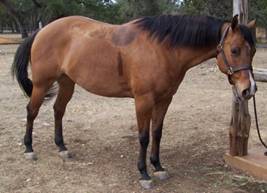
Babe – Feb. 10, 2008
Previous History:
Several days after the auction I was able
to locate the owner listed on her papers by going through the International
Buckskin Horse Association. Maddie
Garman was located in Iowa.
Maddie was surprised Babe had ended up at
an auction in southern Texas.
Maddie had bought her in February of 2005.
Babe was well cared for while owned by
Maddie. Maddie worked on getting her
feet balanced and started training her for events other than pleasure. Her four-beating at the lope was a problem
and Babe had learned how to get out of work.
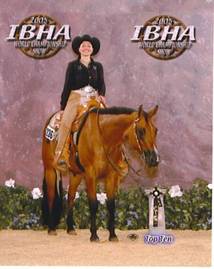
Maddie and Babe at the 2005 IBHA World Show
Maddie won the 2006 International Buckskin
Horse Association Queen title at the IBHA World horse show. Her mount was Babe.
At that time Maddie was going to college,
so finding time to ride was a challenge.
Maddie said she and Babe never got the chance to "click".
In April 2007 Maddie decided to sell Babe
at auction.
Babe was the high selling horse at
$7000.00, but Maddie decided to "no sale" her. After the sale the high bidder approached
Maddie about completing the sale.
The bidder had a client who was looking
for a horse suitable for a youth. He told Maddie that Babe would get a good
home. Maddie thought about it and
decided it might be the best thing for Babe.
Babe's future owner was located in
Wisconsin.
Maddie lost track of Babe until I called
requesting information.
Babe's papers were never transferred out
of Maddie's name. From the time she was
sold in April 2007 until the time I bought her in February 2008 we don't know
what was done with her.
Because none of her three sets of
registration papers were transferred, we knew she had not been shown on the
Quarter Horse or Buckskin circuits.
How
she got from Wisconsin (if that is where she ended up) to San Antonio we will
never know. I tried to call the dealer
who had her at the auction, but he never returned my calls.
Over the last 21 months I have kept Maddie
informed of Babe's progress and Maddie's been helpful in helping me understand
some of Babe's behaviorisms.
Maddie was relieved Babe ended up with a
person who would care for her.
But we both are appalled at the condition
she was in when I got her at the sale.
What's Happened Since February 2008
until the Present - Nov. 19 2009
Physical Issues:
When we got Babe she was showing
tremendous body pain. Just brushing her
made her lay back her ears and move away. She was especially sore in the hock,
stifle, hip and hamstring areas. The unbalanced hooves had been taking a toll
on her body.
During exercise she had trouble with her
stifles. She would buckle during the
lope and lateral movement was restricted.
I contacted Betty Lindquist, who teaches
the online course Equine
Massage for www.horsecoursesonline.com.
I enrolled in the course and with Betty's advice I started massaging Babe. The
course also gave me exercises to improve suppleness and muscle strength.
I also use a product which contains
arnica, called Sore No More, during massage.
Arnica is a perennial plant that is used in homeopathic muscle
ointments.
In
the beginning Babe could barely tolerate being touched. Each session showed improvement and her range
of motion improved during light daily exercise.
Over the past 21 months we've had some set
backs and I've learned what triggers the episodes.
In the beginning Babe was not fit or
supple. She could not do lateral work or
pivots on the hindquarters. Working her
too long on exercises with these maneuvers would cause lameness.
I need to keep her on manicured
ground.
After a rain, when the pasture is muddy
and slippery, she can't be turned out.
Taking a misstep that allows her hind foot to slide in the mud tends to
aggravate her stifles, hocks and hamstrings – triggering lameness.
In the Texas Hill Country we have a lot of
rocks. She had a period of lameness,
which lasted several weeks, after she had slid off a large flat rock with her
right hind leg.
The rocks also mean she must be shod to
protect her soft sole.
I have to avoid working her in arenas with
deep footing and no base. The strain on
her stifles, hocks and hamstrings will trigger soreness.
In July 2006 Maddie had Babe's left hock
x-rayed. Bone spurs were visible in the
hock. It was decided to inject both her
hocks with hyaluronic acid. She was also
given glucosamine injections every other week.
Maddie said the treatment made a big difference in the way she moved.
On Nov. 6, 2009 I had her hocks x-rayed.
The distal metatarsal in the right hock
has significant loss of joint space. The
left hock is not as bad.
It looks like what were bone spurs in the
right hock have comingled to form a bridge.
The joint looks like it is starting to fuse in this area. It could take years for the entire joint to
fuse. Luckily the lower hock does not
have much movement. Fusing in this area
is actually a blessing. In the meantime
I have to control the pain and keep her as comfortable as possible, while
trying to show her.
After talking it over with my vet, Dr.
Jana Robbins, we decided we'll inject her hocks with hyaluronic acid in
January. This should get her through the
show season. In the meantime I'll keep
managing her by using the oral HA (Hyaluronex®), not over stressing the hocks,
rubbing Sore No More on the area, keeping her feet balanced and her weight
down.
Nutrition:
When Babe arrived at her new home, she was
put on a diet - much to her dismay.
The hay in her stall at the auction was
pure alfalfa. Babe is not a dairy cow producing
large quantities of milk, so alfalfa was the worse thing for her. The high calcium and high energy content of
alfalfa was not needed.
But I believe in keeping forage in front
of horses at all times. Her forage was changed from alfalfa hay to coastal
Bermuda grass hay.
Babe was put on a low calorie, balanced
vitamin/mineral supplement. The product
I use is Purina's Enrich 12. She gets a
pound and a half a day (three quarters of a pound twice a day).
Training:
Babe's early training was to prepare her
for western pleasure. Anyone familiar
with how western pleasure horses are expected to move will recognize what a
torque it puts on the joints. Plus
Babe's breeding and conformation were not that of a pleasure horse.
Maddie had started to train her for other
events. But college limited the amount
of time she could spend.
In addition to her physical problems, I
also had the challenge that Babe had become sour and very spoiled.
Because Babe was out of shape and in pain
her exercise program was very light at first.
I also needed to learn her cues.
Maddie was very helpful with giving me insight to those.
The first show I wanted to take her to was
a Quarter Horse show at the Rose Palace in San Antonio. The dates were April 11-13 2008.
During the first three months her daily
exercise program was lunging to warm up and then I rode her for about 45
minutes. We did a lot of jogging,
transitions and started to work on lateral movements.
I was in no hurry. I knew it might be years before we became a
team. I wanted to get her back in shape
slowly, without stressing her too much.
The show dates arrived.
I entered her in amateur western pleasure
and horsemanship. I'm not interested in showing her in western pleasure, but I
wanted to get her in the ring.
Babe and I entered at the walk and I
maintained a good spot on the rail -away from the other entries. She walked and jogged faster than the
pleasure horses, but I expected it.
Then the announcer asked for the
lope.
I gave Babe the cue and she flung her head
in a big wild arc. She took a jump
forward and flung her head again.
Luckily I was by myself on the rail and did not disrupt the class. I went to two hands and got her under
control.
Keeping an eye out for the other
exhibitors I stayed in the lower end of the arena and started making small
circles with her. Every time I asked her
for a lope she would fling her head and leap forward. Once she did it so violently she flipped a
rein over the end of my spur.
I worked my way to the gate and asked to
be let out. Don met me and we looked at
each other in surprise. We never
expected this.
We decided to enter her in open western
pleasure so Don could ride her. He rides
with more leg than I. He would school
her if she tried it with him – she did.
Don had to drive her hard with his legs
and set a barrier with his hands to get her under control. She fought him every step – trying to fling
her head and leap forward.
After the class Don rode her in the
warm-arena. She would not give up. Finally he was able to get her to lope
without swinging her head in a big arc.
He gave her back to me and I walked her to cool her out.
It was the beginning of a very long
summer.
After that first show she started swinging
her head and trying to get out of work at home.
Prior to the show she had not.
I would ride her through it…driving her
forward with my legs and not quitting.
Occasionally Don would ride her.
I have two bulging discs in my back and she was putting a strain on
them.
We tried to make at least two shows a
month. I wanted to show her at the
American Buckskin Registry Association's World Horse Show the end of July
2008. The way she was performing was not
acceptable.
Each outing showed improvement. She would still challenge me and there were
times Don had to ride her, but she was learning she was not going to intimidate
us.
We have a theory that after Maddie sold
Babe and we bought her, she learned how to get out of work by flinging her head
and taking off. Her violent head
swinging could be unnerving and a timid rider would have felt in danger.
The end of July arrived and we made the
trip to the ABRA World Show in Tulsa Oklahoma.
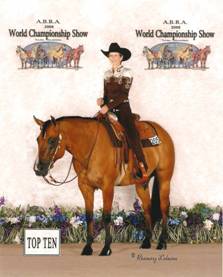
Eleanor and Babe at the 2008 ABRA World Show
I entered her in Amateur Select Trail and
Amateur Select Western Horsemanship. We
got through the classes without her flinging her head and bolting off. She placed sixth in both classes. For us it was like winning a World
Championship.
Since that show she has only regressed
once or twice. But the "weak
moments" were short lived.
Now
we are concentrating on becoming a team.
I've identified the two main things on
which we need to work. They are:
learning not to four-beat at the lope and neck reining better.
Babe is learning how to overcome the
four-beating by loping over poles set in a circle. It's hard to four beat when loping over poles
set six and 12 feet apart on a circle.
The neck reining is being improved by
learning how to listen to my leg. We jog
around a lot of cones and do serpentines.
She has reached the point I can drop the reins on her neck and guide her
with my legs – at the walk and jog.
We're still working on the lope.
Her days of going in mindless circles on
the rail are over.
2009 Show Season
At the ABRA World Show this year Babe
placed fourth in Amateur Select Trail (she was third under one judge). I didn't show her in Western Horsemanship
because I'm not showing her on the rail.
At several open shows she won the trail
class. She's been placing in trail at
the AQHA shows that we've attended in southern Texas.
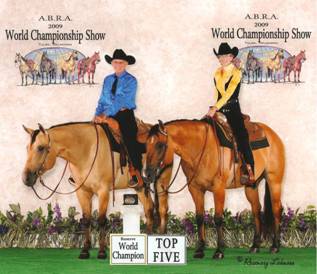
Don Blazer on Commander Pine Bar – 2009 ABRA Junior Trail
Reserve World Champion
Eleanor on Babe – Top Five in Amateur Select Trail at the
2009 ABRA World Show
Babe was year end high point in 2009 on
the Guadalupe Valley Quarter Horse Breeder's show circuit in Open Trail and
Amateur Select Trail.
A Baby for Babe
I really like this mare. Babe's proving she can compete at shows. Her disposition is getting better every day
and she has good conformation.
So I would like to get a foal out of her.
This is not a decision we made
overnight. Don and I do not believe in
breeding mares just because we like them.
The first thing we required of Babe was
for her to prove she can win at shows.
She's been doing that this summer and is getting better.
The second thing we addressed is why do we
want a foal? What are the goals for the
foal? Just to raise a foal out of Babe
is not a good reason.
Babe will be 10 years old in 2010. If I get her bred she'll be 12 when she
foals. I'll be able to show her for
several more years. Her foal will be my
next show horse.
I had a uterine culture done on October
29, 2009 to make sure she did not have an infection. Babe showed no signs of pathogens and
everything looked good.
On November 6 Dr. Robbins performed a
Caslisk to reduce the risk of future infection.
The criteria for the stallion are (not in
any order):
1. Have AQHA points and be a winner.
2. Have the conformation to produce a winner in
trail, western horsemanship and western riding.
3. Have a great disposition.
4. Be the off-spring of winners. This means the dam must be a winner also.
5. Be eye appealing.
Over
the next several months I'll study stallions.
To follow the adventures of Babe's Little
Twister, please go to her blog. Click Here.
Earn a Bachelor of Science degree in equine studies or
certification as a Professional Horse Trainer or Riding Instructor. Start your new career as a riding instructor,
horse trainer, or stable manager. All
courses are online. Start anytime and work at your own pace.
Visit www.horsecoursesonline.com for
information.